About 10 years ago, God started me on a journey that has transformed my walk with Him and radically improved my ability to trust Him. And it all started the day I got fed up with myself.
I had been a Christian since childhood. Like most believers, if you had asked me if I trusted God, I would have replied with an emphatic, “Yes, of course!” But the minute my perceived safety or happiness was remotely threatened, I immediately started to panic. It didn’t seem to matter the size of the threat—whether it was potentially cancer or a cancelled picnic—all I could envision were worst-case scenarios and the world’s worst endings. Questions raced through my mind: Am I going to be OK? How am I going to get through this? What am I going to do?
One day, as I was facing a new trial, I caught myself cycling through my usual anxious thoughts and questions. Frustrated with my lack of faith, I looked at the ceiling and pleaded, “What’s wrong with me, God? Why can’t I just trust You?” To my surprise, He answered me—not in that moment, but a short time later. As I was reading Joshua 4 through my Bible-in-a-year plan, God showed me a simple and ancient strategy for trusting Him using rocks. This chapter recounts the second time God parts water for the Israelites, as Joshua leads God’s people through the Jordan River on dry ground to their promised land.
I had heard this story before, but reading it this time, I noticed that God told Joshua—it was God’s idea—to have 12 men, one from each tribe, pick up a rock from the middle of the Jordan River. Joshua then placed the 12 rocks in a pile as a memorial, so that many years later, when their descendants asked about them, they would have a reminder that God parted water twice for His people. They would recall that He is mighty and extraordinarily powerful, and that they must worship and revere Him forever.
To be honest, my first thought when I read this was, “Well, that’s silly. Why would you need rocks to remember a miracle? Can’t you just remember the miracle?”
Then, I realized, I do that all the time—I constantly forget God’s goodness. Whenever I encounter a new crisis of any size, I tend to get consumed by the problem. All I can think of are the potential calamities in front of me, and I completely forget about the God beside me.
But I wondered what it would be like if I weren’t always so focused on the problem. What if I could turn my attention to Him, my constant God and friend, and remind myself that He’s never made me handle a challenge alone before, and He’s not going to start now. How would I feel facing my giants confidently, knowing that the God of this universe is the God of this situation, and with His hand tightly gripping mine, He’s going to get me through this, one way or another?
I thought, “Maybe I, too, could use rocks as a visual reminder of His faithfulness. Maybe this is how I can start trusting God.”
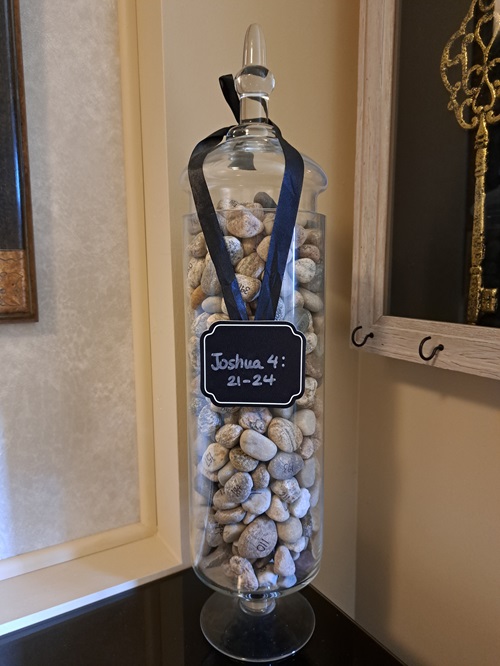
I decided to take God’s advice and make my own pile of rocks, or memory stones, as I call them, to remind myself of His faithfulness. I got myself a tall glass apothecary jar with a lid, a journal, a pen, a Sharpie marker, and a bunch of small, smooth river rocks from outside my house.
My spiritual rock-collecting journey started with me writing in my journal every time I noticed God being faithful in my life. At first, my criterion for what constituted a faithful act was when God answered a prayer or provided for me in any way. Whenever that happened, I would put a rock in the jar. I numbered these journal entries, wrote the corresponding number on a rock, and then placed that rock in the jar.
When I began this journey, my goal was to remember God and His faithfulness so that I could more easily trust Him when I encountered new challenges. It turned out that spiritual rock collecting did three things for me:
1. My ability to trust God increased significantly as I watched His faithfulness pile up. Over time, I found it easier to switch from worry to trust by remembering my rocks and the story of God’s faithfulness behind each one.
2. My gratitude increased from noticing so many areas in my life where God was active, which in turn increased my joy. My goal was to track God’s faithfulness, not increase my gratitude. But you can’t help but be thankful when you discover His hand moving in all areas of your life. It wasn’t my goal, but it has been a welcome side benefit.
3. I developed a deeper and closer relationship with God by collecting these rocks with Him. This has probably been the part of the journey I have cherished most. By asking God to help me see where He’s being faithful and then thanking Him, collecting became an activity I did with God—something we could do together. Collecting rocks with God drew me closer to Him. Also, by reflecting on the stories behind the rocks in my jar, I gained a clearer understanding of who God is and my relationship with Him.
Are you struggling with trusting God? He knows, and He wants to help. Ask Him to show you how He’s already being faithful to you and find a way to chronicle His faithfulness in your life. As you start to believe that He is faithful, you can begin to trust Him, place your concerns in His loving hands, and face your trials with confidence. What are you waiting for?
Tanya Pollard attends Woodvale Pentecostal Church in Ottawa, Ont. You can find Tanya’s book, Memory Stones, on Amazon worldwide. Download the free Study Guide to accompany the book at tanyapollard.com/book. This article appeared in the January/February/March 2026 issue of testimony/Enrich, a quarterly publication of The Pentecostal Assemblies of Canada. © 2026 The Pentecostal Assemblies of Canada. Home page photo by Vinu T on Unsplash. Photo caption: Joshua Tree, California, U.S.A. Photo above © Tanya Pollard. Photo caption: Tanya’s first rock installation (jar) containing rocks #1-403.